Making AI Agents Trustworthy at Scale: Inside Agentforce 360
.png)
At Dreamforce 2025, Salesforce unveiled Agentforce 360, marking a significant evolution from experimental AI to enterprise-grade autonomous agents. For organizations building AI solutions, this release addresses critical challenges around reliability, control, and observability that have hindered production deployments. Here's what developers, architects, and business leaders need to know about the new capabilities that make agents truly production-ready.
The Enterprise Readiness Challenge
The promise of AI agents has always been clear: autonomous systems that can reason, plan, and act on business processes without constant human intervention. However, the reality has been far more challenging. Unlike traditional rule-based automations, agents are non-deterministic by nature they adapt and improvise rather than sticking to scripts. For enterprises handling business-critical processes, this unpredictability has been a major adoption barrier.
Agentforce 360 introduces four foundational pillars designed to bridge this gap: enhanced control through hybrid reasoning, rich context processing via Data 360, multi-channel experiences including voice, and comprehensive management tools for scale. These aren't incremental improvements they represent a fundamental shift in how organizations can confidently deploy autonomous agents in production environments.
Hybrid Reasoning: Balancing Flexibility with Control
The centerpiece of Agentforce 360's reliability improvements is hybrid reasoning, implemented through Agent Script and a configurable Atlas Reasoning Engine. Agent Script is a high-level, declarative domain-specific language that empowers agents with programmatic precision, allowing teams to balance the inherent creativity of LLMs with the certainty of structured business logic.
For developers, this means you can now define agent behavior with conditional logic, precise tool use, and guided controls. The system enables "hybrid reasoning" by balancing the creativity of Large Language Models with structured business logic, ensuring agents can handle tasks requiring strict, sequential steps like order refunds or loan applications while remaining conversational and adaptive.
Technical Implementation:
Agent Script compiles into an "Agent Graph" - a structured specification consumed by the Atlas Reasoning Engine. The Atlas Reasoning Engine employs reinforcement learning and feedback loops to provide accurate, context-sensitive responses, while early pilots have demonstrated a 2x increase in response relevance and a 33% increase in end-to-end accuracy compared to competitors' solutions.
The architecture allows developers to choose where deterministic control is essential and where AI flexibility adds value. You can specify exact workflows for compliance-critical steps while allowing natural language flexibility for customer interactions. This is particularly valuable for regulated industries where audit trails and consistent outcomes are non-negotiable.
Enhanced Builder Experience and Testing
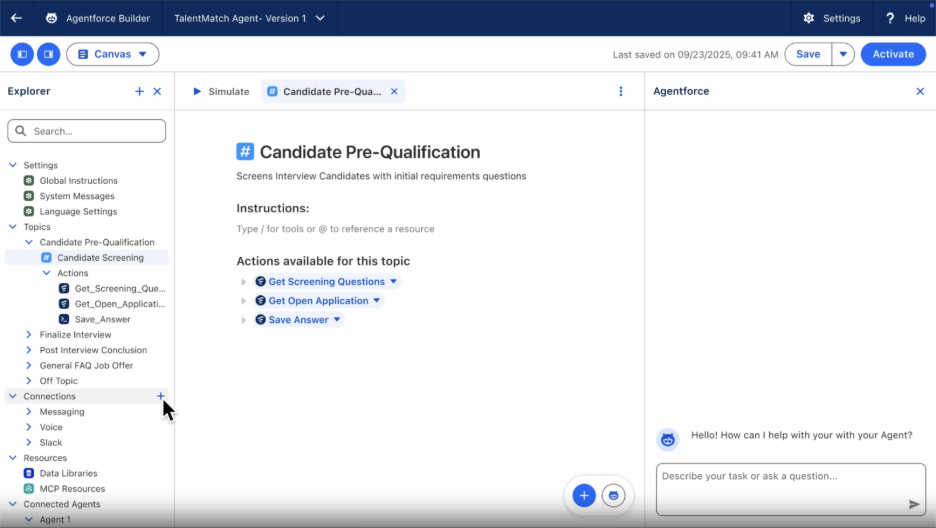
The new Agentforce Builder, entering pilot in November 2025, transforms agent development from a multi-phase process into a unified workflow. The interface provides greater transparency into what the Atlas Reasoning Engine is doing behind the scenes, with a visual simulator and actionable recommendations for agent optimization.
Key Capabilities for Development Teams:
- Multi-view editing: Switch seamlessly between document-style editing with autocomplete, low-code canvas views, and script views for different developer preferences
- Real-time simulation: Test your agent's reasoning, watch each decision step unfold, and adjust instantly before going live
- Integrated testing: Validate agent behavior within the builder, reducing the need for separate batch testing cycles
- Portable format: Every agent compiles into a portable JSON file, simplifying version control and deployment across environments
For architects designing agent systems, this unified approach means faster iteration cycles and better collaboration between technical and business teams. The ability to define agents conversationally and then refine them with code bridges the gap between rapid prototyping and production-grade deployment.
Agentforce Observability: Production Monitoring and Optimization
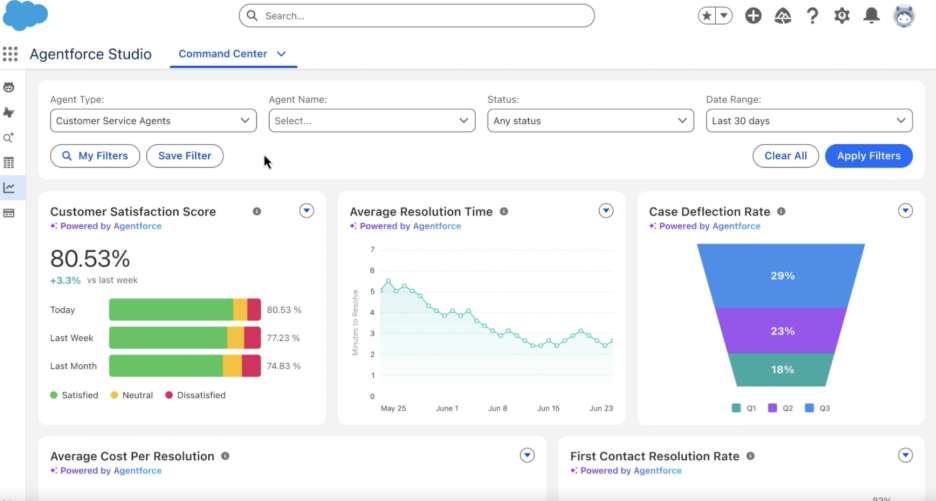
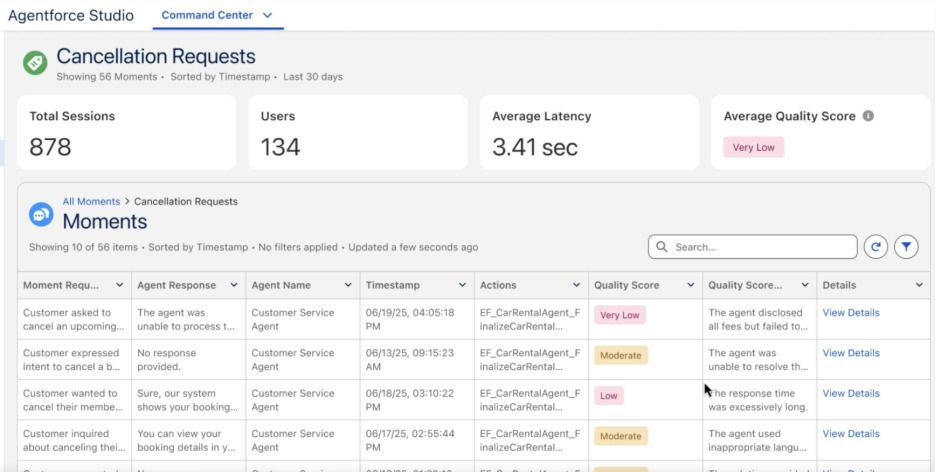
Perhaps the most critical advancement for production deployments is Agentforce Observability, achieving general availability in November 2025. This feature provides detailed analytics and optimization recommendations to improve agent performance, with conversation logs stored in Data 360.
What Observability Delivers:
- Session-level insights: Track individual interactions with fine-grained "Moments" that identify conversation quality issues
- Performance metrics: Monitor total sessions, deflection rates, average latency, and escalation patterns
- Agent-level ROI tracking: Measure business impact with quantifiable metrics
- Optimization recommendations: Receive actionable guidance on refining topic instructions and improving satisfaction scores
These features are critical for enterprise adoption, allowing teams to understand why an agent made a decision, which is essential for trust and troubleshooting. For operations teams, this visibility transforms agents from black boxes into systems that can be continuously improved based on real production data.
Voice Capabilities: Natural Conversational Experiences
Agentforce Voice, now generally available, extends agent capabilities beyond text to natural voice interactions. This isn't simply text-to-speech - it's a native voice layer integrated deeply with Salesforce data and business processes.
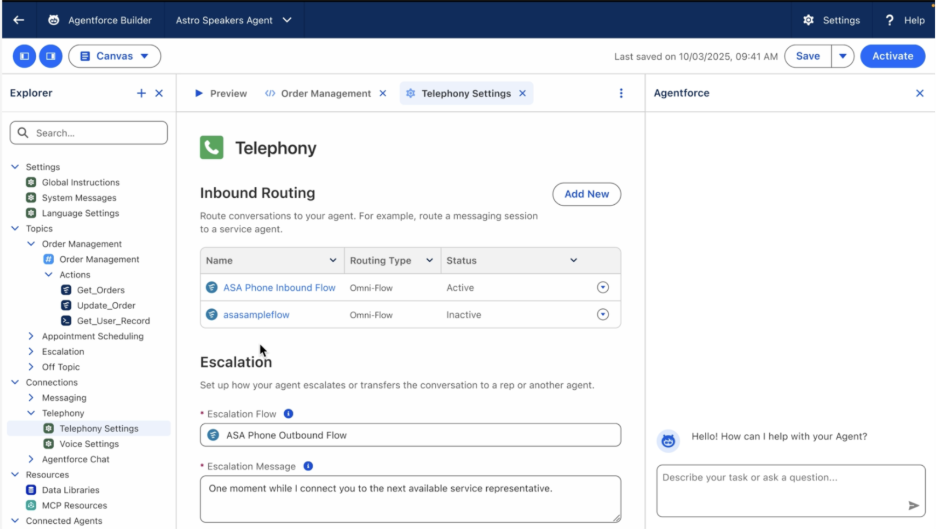
The system features low-latency transcription, realistic speech synthesis, and works across phone systems, websites, and mobile apps. For customer service organizations, this means transforming traditional IVR systems into conversational experiences that maintain context and can execute complex workflows while sounding natural.
Practical Implementation Guidance
For Developers:
Start with Agent Script to define critical workflow steps that require deterministic behavior. Use the Builder's simulation features extensively before deployment. Implement comprehensive logging through Agentforce Observability from day one - waiting until production issues arise is too late.
For Architects:
Design with governance in mind. Salesforce introduced risk-based governance controls that allow organizations to classify automations by sensitivity, letting low-risk workflows run autonomously while routing high-risk actions to human reviewers. Plan your agent architecture around these control points.
Consider data architecture carefully. Agents are only as effective as the data they can access through Data 360. Map unstructured and legacy data sources early, as data quality directly impacts agent reliability.
For Business Leaders:
Focus on specific, high-value use cases for initial deployments. With 12,000 customers, Agentforce 360 has delivered transformative results: Reddit deflected 46% of support cases and cut resolution times by 84%[^1], while Adecco handled 51% of candidate conversations outside standard working hours[^2]. These aren't aspirational - they're production results from early adopters.
Start small but think big. Pilot agentic workflows that integrate collaboration channels like Slack with automated approvals and observability. This provides early wins while building organizational confidence in agent technology.
Agent Interoperability and Multi-Agent Systems
A critical advancement for complex enterprise scenarios is improved agent interoperability. Native support for Model Context Protocol (MCP), Agent-to-Agent (A2A) communication, and Agentforce sub-agents improves collaboration between agents and external systems. This addresses previous limitations where handoffs between agents were error-prone.
For enterprises with multiple business units or complex workflows, this means you can now orchestrate teams of specialized agents that work together. A sales agent can trigger a contract process that an operations agent finalizes automatically through MuleSoft integration, all within governed boundaries.
The Road Ahead: Agent Lifecycle Management
Agentforce 360 introduces a formal agent lifecycle framework spanning four stages: Build, Test, Deploy, and Monitor & Optimize. This mirrors traditional software development practices but accounts for the unique characteristics of autonomous AI systems.
The lifecycle approach means treating agents as deployable software components with version control, implementing continuous testing to validate behavior, extending observability tooling to monitor agent reasoning, and embedding governance policies directly into CI/CD pipelines.
For DevOps teams, this represents new territory. Agents require different testing strategies than traditional code - you're validating reasoning patterns and decision-making, not just input-output correctness. The good news is that Agentforce 360 provides the tools to make this manageable at scale.
Building Trust Through Transparency
The Einstein Trust Layer, which governs how Salesforce handles data and prompts, now extends across every AI workflow in Agentforce and Data 360. Organizations can define how information is used, who has access, and how long interactions are stored - all managed through a unified policy engine.
This foundation of trust is essential for regulated industries. Financial services firms, healthcare organizations, and government agencies need audit trails, data sovereignty controls, and the ability to explain agent decisions to regulators. Agentforce 360 makes this possible without sacrificing the benefits of autonomous operation.
Conclusion: Production-Ready Autonomous Agents
Agentforce 360 represents Salesforce's transition from showcasing AI possibilities to delivering production-grade autonomous agents. The combination of hybrid reasoning for control, comprehensive observability for monitoring, enhanced builder tools for development, and proven customer results creates a compelling platform for enterprise AI adoption.
For technical leaders evaluating agent technology, the key takeaway is this: the tools now exist to build agents that are both powerful and reliable. The non-deterministic nature of AI hasn't been eliminated - it's been channeled through structured frameworks that let you control where precision matters while leveraging AI's adaptability where it adds value.
As organizations move beyond pilot projects to production deployments, Agentforce 360's emphasis on governance, observability, and hybrid reasoning addresses the real barriers to enterprise adoption. The "Agentic Enterprise" is no longer a vision - it's a practical architecture supported by mature tooling.
For Digile clients and partners exploring autonomous agent implementations, the time to engage with these technologies is now. The platform capabilities have matured significantly, early adopter results demonstrate real ROI, and the competitive advantage of effective agent deployment is becoming clear.
.png)
References:
[^1]: Thompson, John (VP of Sales Strategy and Operations, Reddit). Quoted in Salesforce Press Release, October 13, 2025.
[^2]: Matuchet, Pierre (SVP IT & Digital Transformation, Adecco). Quoted in Salesforce Press Release, October 13, 2025.
Contact us to discuss how Agentforce 360 can accelerate your AI initiatives.
For more updates, follow us on LinkedIn, Twitter, Facebook, Instagram, and YouTube
.png)