


Why a Faster Financial Close Starts Before Day One
Why Financial Close Delays Begin Before Consolidation Despite investments in modern fina...
Read more

How Oracle EPM Planning, predictive intelligence and connected enterprise data are reshaping financial planning.
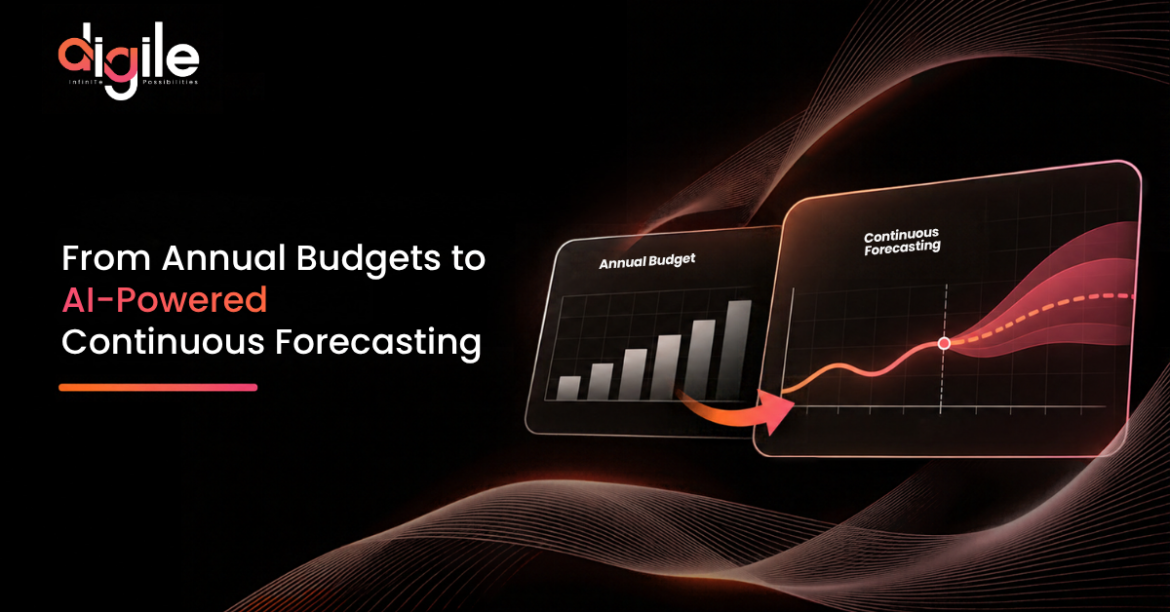
For decades, annual budgeting has been the foundation of enterprise financial planning. Organizations spend weeks or months gathering departmental inputs, reconciling assumptions, negotiating allocations and securing approvals. Once finalized, the budget becomes the benchmark against which performance is measured for the remainder of the year.
The challenge is that business conditions rarely remain static. Changes in customer demand, operating costs, workforce requirements and market conditions can quickly make financial assumptions outdated. Yet many organizations continue to rely on fixed annual budgets supported by periodic revisions and manual forecasting exercises.
Even after implementing cloud-based planning platforms, finance teams often retain the same processes: spreadsheet-driven inputs, lengthy approval cycles and considerable time spent reconciling numbers.
Moving these activities to the cloud may improve accessibility and collaboration, but it does not fundamentally change how planning decisions are made.
The real opportunity is to complement traditional budgeting with continuous, driver-based forecasting, enabling organizations to respond to changing business conditions without losing sight of their financial targets.
This is where Oracle EPM Planning, supported by predictive intelligence and enterprise data integration, can help organizations rethink their approach.
Traditional budgeting typically starts with historical performance, applies assumptions about future conditions and produces a financial plan for a defined period.
While this provides a useful framework for financial control, it can become restrictive when circumstances change.
Continuous forecasting introduces a more dynamic approach.
Instead of relying primarily on an annual planning exercise, organizations maintain rolling forecasts that are periodically updated using actual business performance and revised assumptions.
For example, a manufacturing company may adjust its revenue and cost forecasts based on changes in production volumes, material prices and workforce requirements. A services organization may use sales pipeline information, project utilization and headcount to update its financial outlook.
Budgets and forecasts serve distinct but complementary purposes. A budget establishes the organization’s financial targets and resource commitments, while a forecast provides an updated prediction of expected performance based on current information and evolving business conditions.
Continuous forecasting does not replace the annual budget. Instead, it complements the budget with a more dynamic view of future performance, allowing organizations to assess whether they are on track to achieve their financial objectives and adjust business decisions accordingly.
This creates an important shift in the role of finance. Rather than spending most of the planning cycle collecting inputs and consolidating spreadsheets, finance teams can focus on evaluating assumptions, understanding business drivers and recommending actions.
A critical element of continuous forecasting is identifying the operational factors that have the greatest influence on financial performance.
These may include:
By connecting financial forecasts to a focused set of business drivers, organizations can evaluate how changes in operational conditions affect expected outcomes.
For instance, rather than manually adjusting revenue forecasts across multiple business units, a planning model can calculate the financial implications of revised sales volumes or pricing assumptions.
This approach makes forecasts more responsive and allows finance teams to evaluate alternative scenarios more efficiently.
However, the effectiveness of driver-based planning depends on the quality of the underlying data and the design of the planning model.
Oracle Fusion Cloud EPM Planning provides an integrated cloud environment for financial planning, budgeting, forecasting and scenario analysis.
Its prebuilt planning capabilities, including Financials, Workforce and Capital modules, provide organizations with a structured foundation for developing integrated planning processes. The platform also offers predictive capabilities that can help finance teams move beyond manual forecasting and adopt a more intelligent, data-driven approach.
The opportunity is to combine these capabilities with a planning model designed around business drivers, automated data integration and ongoing performance analysis. Rather than recreating complex spreadsheet models in the cloud, organizations can simplify their planning architecture and use Oracle’s standard functionality wherever possible.
This configuration-first approach helps reduce unnecessary customization and supports a more maintainable planning environment. Custom Groovy business rules can still be introduced where specific business requirements justify them, but they should complement rather than replace standard capabilities.
A leaner planning model can also improve calculation performance and make predictive insights easier to interpret.
One of the most significant developments in enterprise planning is the growing ability to use AI and predictive analytics to support forecast preparation.
Traditionally, finance teams have been responsible for creating forecasts by reviewing historical performance, applying assumptions and manually adjusting projections.
AI introduces a different starting point.
Instead of asking planners to build every forecast from scratch, organizations can use predictive models to generate an initial baseline that finance teams review, challenge and refine.
Oracle EPM Planning offers several capabilities that support this approach.
Oracle Predictive Planning enables finance teams to use historical data to generate statistical predictions and compare them with existing plans and forecasts.
Planners can evaluate predicted values alongside their own assumptions, identify potential differences and incorporate relevant predictions into their forecasting process.
This provides an additional analytical perspective, helping finance teams validate forecasts and make more informed adjustments.
Oracle Auto Predict extends predictive capabilities by allowing organizations to configure and schedule prediction jobs that generate forecast values automatically.
These predictions can be used to populate planning scenarios, providing finance teams with a statistical starting point for their forecasting activities.
Instead of manually preparing every forecast line, planners can review the generated baseline and adjust it to reflect business conditions, strategic initiatives and operational knowledge that may not be captured in historical data.
Together, Predictive Planning and Auto Predict help organizations introduce statistical forecasting into their planning processes while retaining human judgment and control.
Oracle’s Intelligent Performance Management (IPM) Insights can help identify unusual variances, forecasting bias and anomalies.
Rather than relying entirely on manual reviews to discover unexpected movements, finance teams can use these insights to focus attention on areas requiring investigation.
For example, if actual expenditure consistently exceeds forecast assumptions in a particular cost category, IPM Insights may help surface the pattern for review.
This supports a more exception-driven planning process in which finance teams spend less time searching for discrepancies and more time understanding their implications.
Advanced Predictions can extend forecasting beyond historical trends by incorporating multiple business drivers.
For example, a revenue forecast may be influenced by sales pipeline activity, customer demand, pricing changes and market conditions.
When reliable historical information is available, multivariate forecasting can help organizations better understand relationships between operational drivers and financial outcomes.
However, the quality of these predictions depends heavily on the completeness and consistency of the data.
Organizations should therefore establish reliable data foundations before introducing more sophisticated predictive models.
Generative AI also creates opportunities to simplify financial analysis and reporting.
Finance teams frequently prepare management commentary explaining differences between actual performance, forecasts and budgets.
AI-assisted tools can help draft preliminary variance explanations and financial narratives using available planning information.
Controllers and financial analysts can then review, refine and approve the commentary.
This can reduce repetitive drafting work while retaining the human oversight necessary for financial accuracy and accountability.
Together, these capabilities support a shift from manually intensive forecasting toward a more intelligent, analytical planning process.
While AI capabilities attract considerable attention, their effectiveness depends on the information available to the planning system.
An advanced forecasting model cannot consistently produce reliable results if actual financial and operational data arrives late, contains errors or requires extensive manual reconciliation.
In many enterprise environments, planning information is distributed across multiple applications.
Financial actuals may reside in Oracle Fusion or another ERP platform. Workforce information may come from an HCM system. Sales forecasts may be maintained in Salesforce or another CRM platform. Additional inputs may originate from banking systems and operational applications.
When these sources are disconnected, finance teams must spend considerable time collecting and reconciling information before forecasting can begin.
Oracle Integration Cloud (OIC) and native EPM Data Integration can help address this challenge.
For Oracle Fusion environments, native EPM Data Integration can support the movement of financial actuals into Oracle EPM Planning.
OIC can coordinate integrations with non-Oracle systems such as SAP, Workday, Salesforce and banking applications, using scheduled or event-driven workflows.
EPM Automate can support in-application processing activities, while OIC coordinates integration workflows across systems.
A connected planning architecture can follow this sequence:
A connected planning architecture brings financial and operational data from ERP, HCM, CRM and other enterprise applications into Oracle Fusion Cloud EPM Planning through OIC and EPM Data Integration.
Within Planning, organizations can apply driver-based models, predictive forecasting and IPM Insights to support continuous planning and analysis. Results can be accessed through Smart View, dashboards and management reporting.
The integration architecture can also support the controlled write-back of approved planning data to connected enterprise systems, where supported by the target application and configured integration.
Modernizing financial planning is not simply a matter of enabling predictive features.
The underlying planning architecture must be designed to support performance, maintainability and changing business requirements.
Three considerations are particularly important.
Organizations should prioritize the business drivers that have the greatest impact on financial outcomes.
Overly complex models with excessive dimensions, calculations and custom rules can increase processing times and make forecasting more difficult to manage.
Oracle EPM supports different storage approaches for different workloads.
Block Storage Option (BSO) cubes are suited to calculation-intensive planning processes, while Aggregate Storage Option (ASO) cubes can support large-scale reporting and aggregation requirements.
Using the appropriate architecture helps organizations avoid placing every planning and reporting requirement into a single model.
Changes to accounts, organizational hierarchies and planning dimensions should follow defined review and approval processes.
Uncontrolled metadata changes can affect calculation performance and the consistency of predictive results.
Similarly, using EPM Automate for deployment activities, migrations and refreshes can help organizations manage changes more consistently across environments.
These practices help create a planning foundation that can evolve as business requirements change.
Organizations can approach the transition to AI-assisted planning through three phases.
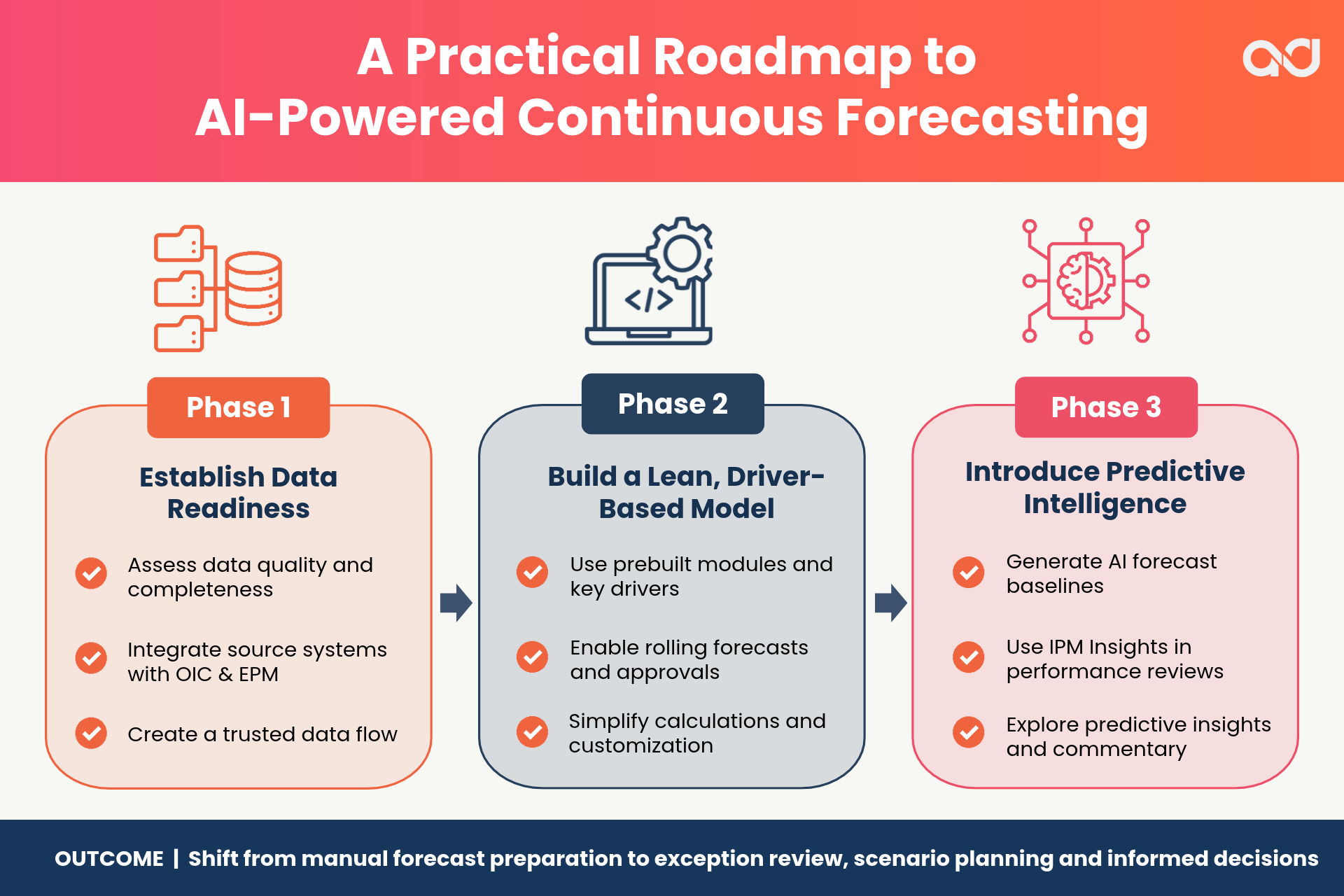
Annual budgets provide the financial targets and accountability that organizations need. Continuous forecasting complements these targets by providing an evolving view of expected performance. Together, they enable finance teams to maintain financial discipline while responding more effectively to changing business conditions.
Continuous forecasting provides a more adaptable foundation, while AI and predictive analytics can help finance teams identify patterns, evaluate assumptions and improve the efficiency of forecast preparation.
The greatest value comes when these capabilities are supported by connected enterprise data, well-designed planning models and appropriate governance.
At Digile, we help organizations modernize their Oracle planning environments by combining Oracle EPM Planning expertise with Oracle Integration Cloud, data integration and AI-assisted forecasting capabilities.
Our approach focuses on building reliable data foundations, simplifying planning processes and introducing predictive intelligence where it can deliver meaningful business value.
The future of financial planning isn’t about producing more budgets. It’s about creating better forecasts, understanding what drives them and making decisions with greater confidence.
Discover how Digile can help your organization move toward connected, AI-assisted financial planning with Oracle EPM.
Why Financial Close Delays Begin Before Consolidation Despite investments in modern fina...
Read more
The Enterprise Application Model Is Changing For decades, enterprise technology strategie...
Read more
When companies talk about enterprise AI, the conversation usually starts with transformati...
Read more