

The Enterprise Application Model Is Changing
For decades, enterprise technology strategies have been built around applications. Organizations invested in ERP systems to manage operations, CRM platforms to support customer relationships, HCM solutions to manage their workforce, and specialized applications to address industry-specific requirements.
These systems became the digital backbone of the enterprise. Yet, as organizations expanded their technology environments, they also introduced complexity. Business processes became distributed across multiple platforms, information was fragmented, and employees often had to navigate several applications to complete a single task.
Artificial intelligence is beginning to challenge this operating model.
The opportunity is no longer limited to improving individual applications with AI-powered features. Enterprises can now rethink how work gets done by connecting information, intelligence, and actions across their technology landscape.
Imagine a sales leader asking an AI assistant why a strategic account is underperforming. Instead of manually reviewing CRM records, financial transactions, service tickets, and account communications, the assistant could analyze information across these systems, identify potential causes, and recommend corrective actions. With appropriate authorization, AI agents could also initiate follow-up workflows.
The underlying applications remain important, but the way employees interact with them changes significantly.
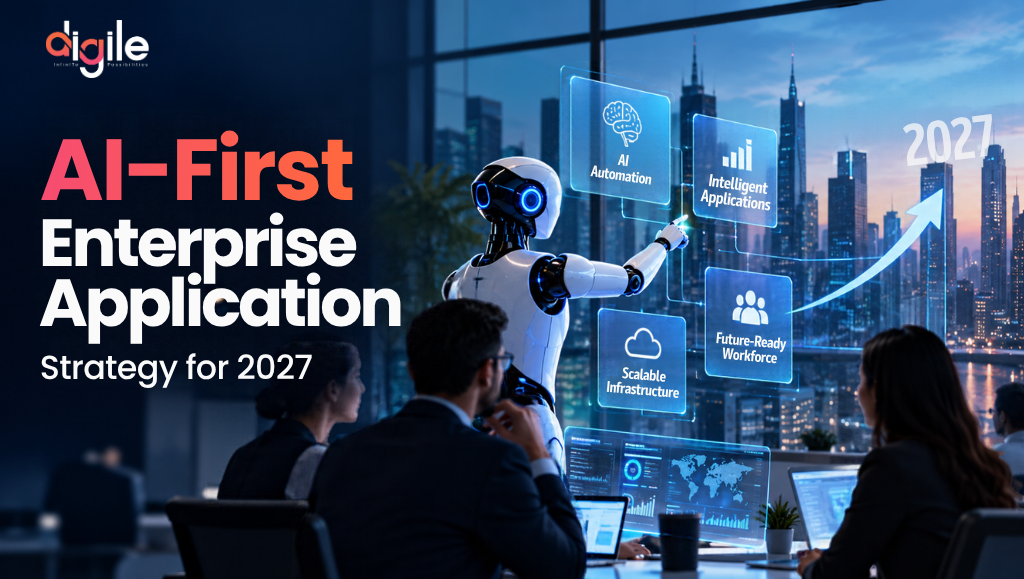
As enterprises plan for 2027, the strategic question is shifting from which applications they need to how applications, data, AI, and business processes can work together as an intelligent operating environment.
This requires a fundamental reassessment of enterprise architecture, modernization priorities, governance, and technology investments.
Moving from Application-Centric to Intelligence-Centric Architecture
Traditional enterprise architectures are organized around individual systems, each responsible for specific business functions and transactions. Although integration platforms have improved connectivity, many workflows still depend on employees moving between applications, interpreting information, and coordinating activities manually.
An AI-first architecture introduces a different approach. Rather than treating each application as a separate destination, it creates an intelligent layer through which employees and business processes can access information and execute tasks across systems.
This emerging architecture can be understood through four interconnected components.
- Systems of Record: Core platforms such as ERP, CRM, HCM, and industry applications continue to manage authoritative business data, transactions, and operational processes.
- Enterprise Intelligence: A connected intelligence layer brings together structured data, documents, organizational knowledge, business rules, and operational context to support AI-driven analysis and decision-making.
- AI and Agent Orchestration: AI models, intelligent agents, and orchestration technologies coordinate tasks and workflows across applications, enabling more integrated business processes.
- Intelligent Experiences: Conversational interfaces, AI assistants, and role-specific experiences allow employees to interact with enterprise technology through natural language and business objectives rather than navigating individual applications.
This architecture does not eliminate existing enterprise systems. Instead, it changes their role within the broader technology environment.
For CIOs, the implication is significant. Application strategy can no longer be evaluated solely through functionality, licensing costs, or individual platform capabilities. Interoperability, access to enterprise context, and the ability to participate in intelligent workflows must become equally important considerations.
Enterprise Context Will Become a Strategic Differentiator
AI models are becoming increasingly capable and accessible. However, powerful models alone do not guarantee meaningful enterprise outcomes.
An AI system may understand general business concepts, but it does not inherently understand an organization’s customers, contractual obligations, internal policies, operational processes, or historical decisions.
That understanding comes from enterprise context.
Consider an AI agent supporting procurement decisions. To evaluate a supplier effectively, it may need to consider purchasing history, contractual terms, delivery performance, quality issues, financial exposure, and internal procurement policies. This information is rarely available within a single application.
An effective AI-first strategy must therefore move beyond traditional data integration toward connecting enterprise knowledge and business context.
This requires organizations to strengthen several capabilities, including consistent business definitions, secure information access, contextual retrieval, knowledge management, and data quality.
Technologies such as retrieval-augmented generation, semantic layers, knowledge graphs, and enterprise search can help establish this foundation. However, technology must be supported by clear data ownership, governance, and information management practices.
The competitive advantage will increasingly come from how effectively enterprises combine AI with their proprietary knowledge, operational expertise, and business relationships.
Two organizations using the same AI model may achieve very different outcomes depending on the quality and accessibility of their enterprise context.
For technology leaders, this makes enterprise intelligence architecture a strategic investment rather than simply another data management initiative.
Agentic AI Will Shift Enterprise Applications from Insight to Execution
The first wave of enterprise generative AI focused primarily on improving individual productivity. AI assistants helped employees summarize information, draft communications, retrieve knowledge, and generate reports.
Agentic AI introduces the potential for a more fundamental change.
Rather than simply responding to requests, AI agents can be designed to interpret objectives, plan activities, interact with enterprise systems, and execute defined tasks within established boundaries.
Consider a customer onboarding process involving sales, finance, legal, and operations. Traditionally, employees coordinate information, approvals, documentation, and system updates across multiple applications.
An AI-enabled workflow could retrieve customer information, validate documentation, identify missing requirements, prepare account records, and coordinate approvals. Routine activities could be automated, while complex exceptions or high-risk decisions remain subject to human review.
The value extends beyond reducing manual effort. It includes faster cycle times, fewer handoffs, improved consistency, and better customer experiences.
However, organizations must establish clear boundaries around what AI agents can access, which decisions they can make, and when human authorization is required. Identity management, transaction permissions, monitoring, and auditability become essential architectural capabilities.
Not every workflow requires autonomous execution. In many situations, AI-assisted recommendations or human-approved actions may deliver the best balance of efficiency and control.
The priority for 2027 should therefore be controlled, outcome-driven autonomy, with AI capabilities introduced according to business value, operational risk, and organizational readiness.
Modernization Without Disrupting Core Enterprise Operations
An AI-first strategy does not require replacing every legacy application. Most enterprises have made substantial investments in platforms that continue to support critical operations, regulatory compliance, and business continuity.
The challenge is ensuring these systems can participate in a more intelligent and connected architecture.
Rather than approaching modernization as a large-scale replacement exercise, organizations should evaluate applications based on business relevance, integration flexibility, technical debt, and AI readiness.
Applications that remain effective can be extended through APIs, integration services, and AI-powered interfaces. Systems with restrictive architectures may require targeted modernization, while redundant applications should be consolidated or retired.
Without deliberate rationalization, AI adoption risks becoming another permanent layer of technology complexity, increasing costs rather than simplifying operations.
Enterprises must also consider deployment flexibility. AI workloads may have different requirements for computing capacity, data residency, security, latency, and cost. Hybrid architectures that combine cloud, private infrastructure, and existing enterprise platforms may therefore offer advantages.
The goal is not to create an entirely new technology estate for AI, but to make the existing estate more adaptable, interoperable, and intelligent.
Redesigning Business Processes, Not Just Automating Tasks
One of the biggest limitations of enterprise AI adoption is the tendency to apply new technology to existing processes without questioning how those processes are designed.
An AI assistant may reduce the time required to prepare a customer service response. However, if resolving the issue still involves multiple departments, disconnected systems, and lengthy approvals, the overall business impact may remain limited.
This highlights the difference between task-level productivity and process-level transformation.
An AI-first approach starts with the desired business outcome and works backward to determine how people, applications, and intelligent systems should collaborate.
For example, rather than automating individual steps in customer onboarding, an enterprise could redesign the entire journey to reduce manual handoffs, accelerate verification, coordinate approvals, and improve customer experience.
Similarly, finance teams could move beyond automating reconciliations toward continuously identifying anomalies, improving forecasting, and accelerating financial decision-making.
This requires closer collaboration between business and technology leaders. Process owners must define outcomes, technology teams must enable intelligent execution, and risk functions must establish appropriate controls.
The most significant opportunities will emerge when enterprises use AI to eliminate unnecessary complexity rather than simply perform existing activities faster.
Building Governance and Trust into AI-First Architecture
As AI systems evolve from providing information to executing business activities, governance becomes an architectural requirement.
An AI agent interacting with financial systems, customer records, or operational platforms must operate within clearly defined permissions. Organizations need visibility into which systems an agent accesses, what information it uses, which actions it performs, and who remains accountable.
This introduces new requirements for identity management, authorization, auditability, and continuous monitoring. Enterprises must also establish mechanisms to evaluate AI performance, detect unexpected behavior, protect sensitive information, and intervene when necessary.
Governance should extend beyond individual models to cover the complete AI operating environment, including data sources, integrations, third-party services, and automated workflows.
Importantly, effective governance should enable innovation rather than restrict it. Reusable security standards, clearly defined autonomy levels, and consistent monitoring practices can help organizations deploy AI more confidently across business functions.
For senior leaders, trust must become a measurable characteristic of enterprise AI operations, not simply a compliance consideration addressed after deployment.
Moving from AI Adoption to Measurable Business Value
As enterprise AI investments grow, leadership teams will face increasing pressure to demonstrate financial and operational returns.
Early AI initiatives often focused on adoption rates, productivity improvements, and the number of use cases deployed. While these indicators are useful, they do not necessarily demonstrate enterprise-wide value.
For example, saving employees several hours each week creates potential capacity, but that capacity does not automatically translate into reduced costs or increased revenue.
Realizing financial benefits may require changes to workflows, resource allocation, service delivery, or operating models.
An effective AI-first application strategy should therefore connect every major investment to measurable business outcomes.
These might include reducing the cost of customer service, shortening sales cycles, improving inventory performance, accelerating financial close processes, or increasing revenue per employee.
Organizations should establish baseline metrics, define expected improvements, assign business ownership, and continuously evaluate realized benefits.
The economics must also account for AI infrastructure, model consumption, integration, governance, and ongoing maintenance costs.
By 2027, successful enterprise AI strategies will be distinguished less by the number of AI capabilities deployed and more by their contribution to business performance.
Five Priorities for Building an AI-First Enterprise in 2027
For CIOs and enterprise transformation leaders, translating this vision into action requires a practical roadmap.
- Reassess the application portfolio through an AI-first lens. Identify which systems remain strategically important, where integration barriers exist, and which applications create unnecessary complexity. Prioritize modernization investments that improve enterprise connectivity and flexibility.
- Establish a connected enterprise intelligence foundation. Improve access to structured and unstructured information, strengthen data governance, and make business context available to AI systems through secure, reusable services.
- Prioritize high-value, cross-functional workflows. Move beyond isolated productivity use cases. Focus on processes where intelligent coordination can reduce friction, accelerate decisions, and improve measurable business outcomes.
- Build governance and operational readiness for agentic AI. Define appropriate levels of autonomy, establish agent identity and authorization standards, and implement monitoring, accountability, and human oversight mechanisms.
- Align technology investments with business transformation. Create shared accountability between IT, business, finance, and risk leaders. Measure outcomes against financial and operational objectives rather than technology adoption alone.
These priorities should be pursued as connected initiatives rather than independent projects. The effectiveness of AI-enabled workflows depends on the strength of the underlying architecture, enterprise context, governance, and organizational readiness.
The Future Enterprise Will Be Defined by How Intelligently It Operates
Enterprise applications are not disappearing. Their role within the organization is evolving.
ERP, CRM, HCM, and industry platforms will continue to provide the transactional foundation of business operations. However, the next phase of enterprise transformation will increasingly depend on how effectively these systems connect with AI, enterprise knowledge, and intelligent workflows.
For enterprise leaders, 2027 presents an opportunity to move beyond incremental application enhancements and rethink how technology supports business performance.
This means modernizing selectively, connecting enterprise intelligence, redesigning processes, enabling controlled AI autonomy, and establishing clear accountability for outcomes.
The organizations that succeed will not necessarily be those that deploy the most AI tools. They will be those that integrate intelligence into the way their businesses operate, make decisions, and create value.
The defining shift for 2027 is from managing enterprise applications to orchestrating enterprise intelligence.
