


When companies talk about enterprise AI, the conversation usually starts with transformation at scale: Autonomous Agents, Reimagined Business Processes, AI-powered customer experiences, and entirely new ways of working. These are important ambitions, but they can sometimes obscure a much more immediate opportunity.
Across almost every organization, employees lose small pockets of time to work that is necessary but adds very little value. A manager comes out of back-to-back meetings and spends half an hour catching up on Slack and email. A team member searches through old conversations to understand why a decision was made. Someone checks several sources before determining whether an action complies with policy. Another employee gathers information from multiple systems just to prepare a simple update.
None of these tasks looks significant enough to warrant a major transformation initiative. Yet repeated across teams, functions and thousands of employees, they represent a substantial amount of organizational capacity.
This may be one of the most overlooked opportunities for enterprise AI: not replacing the work people do – but reducing the friction surrounding it.
Consider the first 30 minutes of the day
For many executives, managers and project leads, the working day begins with reconstruction.
While they were in meetings, travelling or focused on another priority, conversations continued. Slack channels accumulated messages. Emails arrived. Questions were raised, decisions were made, documents were shared and actions were assigned. The information is all there, but understanding what happened requires someone to work through it.
That everyday problem inspired the Slack & Email Summary Agent developed by Digile using Glean.
The idea behind the agent is simple: instead of requiring users to manually work through multiple communication streams, bring the relevant information together and help them quickly understand what changed, what matters and what requires their attention.
The important word here is relevant. Summarization itself is no longer particularly novel. Almost any generative AI tool can shorten a piece of text. The enterprise challenge is considerably harder. The AI needs enough context to distinguish an FYI from a decision, an interesting conversation from an urgent issue, and general discussion from something that requires action.
When it works, the benefit isn’t simply a shorter inbox. It is a faster route back into productive work.
The 30-minute problem is much bigger than email
Once you start looking for these small pockets of friction, they appear everywhere.
Employees spend time finding the latest version of a document, tracing decisions through lengthy conversations, checking content against internal policies, researching competitors before meetings, reconciling information from different systems and preparing status reports from multiple sources. Knowledge workers have become remarkably good at stitching together fragmented information, often without realizing how much of their working day it consumes.
This is where the economics become interesting.
Consider an organization with 5,000 employees. If AI could return just 30 minutes to each employee every day, it would mean approximately 650,000 hours of capacity saved annually.
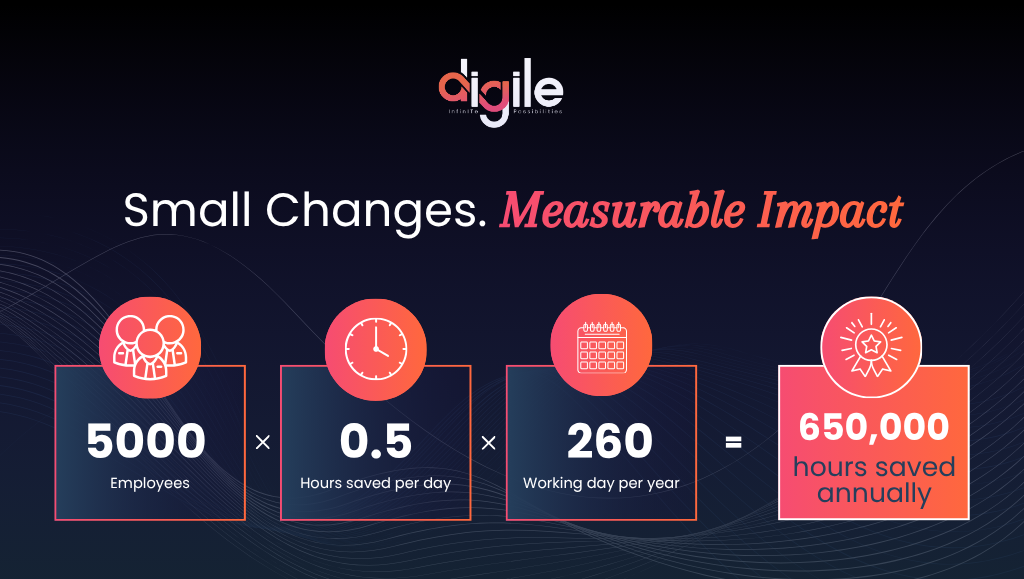
The opportunity becomes much larger when we stop thinking about one task and start looking at the accumulation of dozens of small tasks across the working day.
For organizations building an AI business case, this also offers a different way to think about ROI. AI value doesn’t have to come exclusively from eliminating entire processes or reducing headcount. It can come from giving skilled people more time to apply the judgment, creativity and expertise they were hired for.
Employees have quietly become the integration layer
Enterprises have invested heavily in technology intended to make work more efficient, yet the information employees need has become increasingly distributed.
A conversation happens in Slack. Supporting information sits in a document repository. Customer history lives in the CRM. A policy is stored elsewhere. An important clarification arrived by email six months ago. Employees bridge these systems manually, searching, switching applications, reading, comparing and reconstructing context before they can make a decision.
Traditional enterprise search improved our ability to find information. Generative AI made it easier to ask questions about that information. But the next step is more consequential: enabling AI to understand enough of the context surrounding a task to help move the work itself forward.
That requires something generic AI assistants often lack: ENTERPRISE CONTEXT.
An AI model may understand what a “project update” is, but does it understand your project? Does it know which conversations are relevant, which documents are authoritative, who is involved, what was decided last week and what has changed since yesterday?
Without that context, AI can generate impressive answers. With it, AI can become genuinely useful inside the flow of work.
Why our partnership with Glean matters
This is the opportunity Digile has been exploring closely with Glean.
Glean provides the enterprise AI foundation that connects people with the knowledge, context and information distributed across their organization. Digile brings the consulting, engineering and domain expertise required to identify high-value opportunities and translate them into agents built around real business workflows.
Together, the focus is not simply on giving employees another AI interface. It is on identifying where work slows down and designing intelligent experiences around those moments.
The Slack & Email Summary Agent is a good illustration. The underlying problem isn’t that people cannot read their email or search Slack. The problem is the cognitive effort required to continuously absorb information from both, determine what is relevant and translate that information into action.
Reducing that effort is where AI begins to deliver meaningful value.
The same pattern appears in very different workflows
Our work around Glean has also shown that the “30-minute problem” isn’t limited to productivity or communication.
Consider compliance review. The difficult part is rarely finding one policy document. Someone needs to understand the content being reviewed, determine which requirements apply, identify potential issues and document those findings in a useful format. Much of the time involved is spent gathering and structuring the context around the eventual judgment.
Restricted-party screening follows a similar pattern. Information may need to be gathered from multiple sources, entities compared and screening criteria applied before someone can reach and document a conclusion.
Competitive benchmarking presents another variation. Teams can spend hours gathering information, organizing findings, comparing alternatives and turning research into something decision-makers can actually use.
These appear to be completely different business problems, but they share an underlying characteristic: people spend a disproportionate amount of time preparing the context required to do the part of the job that actually needs their expertise.
That is fertile ground for enterprise AI.
Don’t start by asking which jobs AI can automate
Perhaps the more useful question for an AI strategy is much smaller: Where are people repeatedly losing 10, 20 or 30 minutes?
Look for processes where employees routinely search across several systems, read large amounts of information to extract a few relevant facts, reconstruct context before making a decision, compare information against established rules, create repetitive summaries or move information manually between workflows.
These tasks may not look impressive on an AI transformation roadmap. In many cases, however, they are precisely where AI can deliver value quickly because the objective isn’t to eliminate human judgment. It is to remove the repetitive work that precedes it.
There is also an adoption advantage. Asking employees to completely change how they work can create resistance. Giving someone a tool that turns a familiar 30-minute task into a five-minute task is a very different proposition. The benefit is immediate, personal and easy to understand.
Small improvements can add up to transformation
Enterprise AI does not necessarily need to arrive as one enormous transformation program.
One well-designed agent might save a team a few hours every week. Another might accelerate a compliance process. Another might make institutional knowledge accessible in seconds. Another might dramatically reduce the research required before a decision.
Individually, each solves a relatively contained problem. Across an enterprise, however, these agents can begin to remove friction from hundreds of points in the working day.
That accumulation matters. Saving 20 minutes here and 30 minutes there may sound incremental but multiply those savings across thousands of people and millions of interactions and the impact becomes anything but small.
It also suggests a pragmatic path for organizations struggling to decide where to begin with enterprise AI. Rather than searching immediately for the biggest possible AI use case, start by finding the work everyone quietly wishes they didn’t have to do.
The half hour spent catching up after meetings. The 20 minutes spent looking for the right policy. The repeated search for information that someone knows exists somewhere. The manual comparison that happens every week. The status update assembled from five different sources.
These moments rarely make it onto transformation roadmaps. Yet they happen every day.
Find your hidden 30 minutes
The Slack & Email Summary Agent is ultimately a simple example of a much larger idea.
Its value isn’t that AI can summarize Slack messages or emails. The real value comes from connecting AI to the context surrounding someone’s work so that it can surface what matters, reduce the effort required to catch up and help people move more quickly to the decisions and actions that need them.
That is also at the heart of Digile’s work with Glean: moving enterprise AI beyond impressive demonstrations and into the everyday workflows where measurable value can actually be created.
The biggest AI opportunity in your organization may not be a process that takes six months to transform. It might be a task that takes 30 minutes.
The question is how many times a day it happens.
