


For many enterprises, the AI conversation has changed dramatically.
A few years ago, the question was “Where can we use AI?” Today, most organizations can identify dozens, sometimes hundreds, of possibilities. Customer service, knowledge discovery, software development, operations, finance, supply chain, sales, compliance and employee productivity all present compelling opportunities.
The harder question is now:
How do we turn all this AI activity into measurable, repeatable business impact?
That is where many organizations are discovering a gap between adopting AI and operating with AI.
A successful proof of concept proves that something can work. Enterprise AI requires proving that it can work reliably, securely, economically and repeatedly across the organization.
Recent research reflects this challenge. Deloitte notes that more than 70% of organizations have implemented only a third of their generative AI projects, highlighting how difficult it remains to move from experimentation to enterprise-wide adoption. (Deloitte) McKinsey similarly points to data readiness as an increasingly important constraint as organizations attempt to move AI pilots to scale. (McKinsey & Company)
The organizations that succeed will therefore need to think beyond individual AI projects. They need an enterprise AI lifecycle, a structured path that connects business strategy, use-case discovery, data, technology, governance, deployment, adoption and continuous value creation.
AI Should Begin With Business Strategy, Not Technology
One of the easiest mistakes to make with AI is starting with the model.
Which LLM should we use? Should we build an agent? Do we need RAG? Should we deploy copilots? Should we use an open-source model?
These are important questions, but they come later.
The first question should be:
What does the business need to do materially better?
Perhaps a manufacturer wants to reduce unplanned downtime. A bank wants to shorten the time required to investigate suspicious transactions. A telecom operator wants to improve field-service productivity. An engineering organization wants employees to find technical knowledge faster. A sales organization wants account teams to spend less time searching across CRM, email, documents and collaboration platforms.
Starting with the business problem changes the conversation.
Instead of asking:
“Where can we deploy generative AI?”
the organization asks:
“Where are decisions slow, knowledge fragmented, processes inefficient or opportunities being missed, and can AI meaningfully change the outcome?”
This distinction matters because an enterprise AI strategy should not become a catalogue of technologies. It should define the business outcomes AI is expected to influence and establish how those outcomes will be measured.
That means connecting AI priorities to strategic objectives such as revenue growth, operational efficiency, customer experience, risk reduction, workforce productivity, resilience or innovation.
From a List of Ideas to a Portfolio of Use Cases
Once strategic priorities are clear, organizations usually discover no shortage of potential use cases.
The challenge becomes prioritization.
Not every process that can use AI should use AI. And not every impressive demonstration deserves to become a production application.
A useful way to evaluate AI opportunities is across four dimensions:
Business value. What measurable outcome could change? Revenue? Cost? Productivity? Risk? Cycle time? Customer satisfaction?
Feasibility. Is the required data available? Can the AI integrate with the systems and workflows involved? Is the technology mature enough?
Risk and governance. What happens if the AI is wrong? Is sensitive information involved? Does the use case affect customers, employees, financial decisions or regulated processes?
Scalability. Is this solving a one-off problem, or could the underlying capability be reused across multiple teams, processes or business units?
This moves organizations away from the familiar trap of accumulating disconnected proofs of concept.
Instead, AI becomes a managed portfolio.
Some opportunities may deliver quick productivity improvements. Others may require deeper process transformation. A smaller number may have the potential to fundamentally change how the organization operates.
The portfolio should contain all three, but with different expectations, investment levels and governance requirements.
The Missing Layer: Enterprise Context
An AI model knows what it was trained on.
It does not automatically know how your organization works.
It does not inherently understand your products, policies, customers, contracts, operating procedures, organizational relationships, approval structures, historical decisions or business terminology.
And increasingly, this enterprise context is where the real value lies.
For an employee asking a generic question, general intelligence may be enough.
For an AI system deciding which maintenance ticket should be escalated, summarizing a customer relationship, recommending a next action on a sales opportunity, reviewing a contract against company policy or assisting an engineer with a technical problem, generic intelligence is not enough.
The AI needs trusted business context.
That requires bringing together structured data from systems such as ERP, CRM and operational platforms with unstructured knowledge contained in documents, emails, conversations, policies, manuals and other enterprise repositories.
As McKinsey argues, scaling AI increasingly depends on connecting structured and unstructured data into governed, reusable foundations. (McKinsey & Company)
This is why data readiness and AI readiness are becoming inseparable.
The quality of enterprise AI will increasingly depend not simply on how intelligent the underlying model is, but on how effectively that intelligence can access and interpret the organization’s own knowledge.
Build the Foundation Once, Not for Every Use Case
The next challenge appears when successful pilots begin multiplying.
Imagine five teams developing five AI applications.
One builds its own authentication mechanism. Another creates a separate vector database. A third establishes its own model access. Another develops a different monitoring framework. Each team creates separate connectors to enterprise systems.
Individually, every decision may appear reasonable.
Collectively, the organization is creating the next generation of technology fragmentation.
Enterprise AI therefore needs a shared foundation.
That foundation can include capabilities such as:
- secure model access and model management
- enterprise data and knowledge integration
- identity and access controls
- retrieval and grounding services
- agent orchestration
- API and application integration
- observability and monitoring
- evaluation frameworks
- security and privacy controls
- governance and auditability
- reusable prompts, agents, connectors and components
The objective is not to force every AI application into exactly the same architecture. It is to avoid rebuilding the same foundational capabilities every time a new use case emerges.
The economics of AI change significantly when organizations move from building individual applications to creating reusable enterprise capabilities.
The first use case creates a solution. The next ten should benefit from the foundation it helped create.
Move From Proof of Concept to Proof of Value
A technically successful pilot is not necessarily a valuable AI system.
This distinction becomes important when organizations evaluate whether an initiative should move into production.
A proof of concept typically asks:
Can the technology perform the task?
A proof of value asks:
Does performing this task differently create enough measurable value to justify deploying and operating it at scale?
Suppose an AI assistant can reduce the time required to prepare a customer proposal from three hours to forty minutes. That sounds promising.
But the enterprise still needs to understand what happens next.
Do employees actually use it? Does proposal quality remain consistent? Does it shorten the sales cycle? How often must humans correct the output? What does each interaction cost? Can the system handle thousands of users? Does it expose sensitive customer information? Does it integrate naturally into the existing sales workflow?
These questions turn AI evaluation from a model-performance exercise into a business-performance exercise.
That is the transition from “Does the AI work?” to “Does the AI create value when people actually use it?”
Governance Cannot Be a Final Gate
As AI becomes embedded in enterprise processes, governance becomes part of the architecture rather than a compliance exercise performed before launch.
The NIST AI Risk Management Framework reflects this lifecycle approach through four interconnected functions: Govern, Map, Measure and Manage, with governance intended to operate across the AI lifecycle rather than as a single checkpoint. (NIST)
For enterprises, this means questions around privacy, security, explainability, accountability, model behaviour, human oversight and auditability need to be considered from the beginning.
A customer-service assistant may require one level of control.
An AI system recommending financial decisions requires another.
An autonomous agent capable of executing transactions or changing enterprise systems requires another level entirely.
The more AI moves from answering to recommending to acting, the more important these controls become.
A mature enterprise therefore does not ask simply:
“Is AI allowed?”
It asks:
“Under what conditions should this AI system be allowed to operate?”
That creates a much more practical approach to responsible AI.
Deployment Is Not the Finish Line
One of the most underestimated parts of the AI lifecycle begins after production deployment.
AI does not create value simply because it exists.
People have to use it.
Processes may need to change. Roles may need to evolve. Employees need to understand when AI should be trusted, when its output should be challenged and when human judgment remains essential.
Deloitte highlights workforce trust, communication and role transformation as important elements in scaling AI, noting that organizations need to communicate responsibilities, workflow changes, outcomes and lessons learned as adoption grows. (Deloitte)
This makes change management an integral part of AI engineering.
If an AI solution saves employees twenty minutes but requires them to leave the system where they normally work, adoption may suffer.
If it generates excellent recommendations but employees do not understand how they were produced, trust may suffer.
If it automates part of a workflow but leaves the surrounding process unchanged, the organization may simply move the bottleneck somewhere else.
The best enterprise AI solutions therefore do not sit beside work.
They become part of how work happens.
Measure Outcomes, Not AI Activity
As enterprise AI matures, its metrics must mature with it.
Counting models, copilots, agents, prompts or deployed use cases tells leaders how much AI activity exists. It says little about whether that activity is creating value.
A stronger measurement framework connects three layers.
Technical performance asks whether the system is accurate, reliable, secure, responsive and cost-efficient.
Adoption performance asks whether people are actually using it and whether it is changing behaviour or workflows.
Business performance asks whether the intended outcome has improved.
For example:
AI customer-service agent
Technical metric → response quality
Adoption metric → percentage of interactions supported by AI
Business metric → reduced resolution time and higher first-contact resolution
AI knowledge assistant
Technical metric → retrieval accuracy
Adoption metric → active users and queries
Business metric → reduced time spent searching for information
Predictive maintenance AI
Technical metric → prediction precision
Adoption metric → percentage of alerts acted upon
Business metric → reduction in downtime and maintenance cost
This creates an important discipline.
If the business metric does not improve, the organization must be willing to redesign, retrain, reposition or retire the AI system.
AI portfolios need exit criteria as much as investment criteria.
Scale the Capability, Not Just the Application
This is where the enterprise AI lifecycle begins to compound.
Imagine the first AI use case requires connecting to ERP data.
The second requires CRM.
The third requires engineering documentation.
The fourth requires customer-service history.
If each initiative creates reusable connectors, governance controls, retrieval capabilities, evaluation methods and orchestration patterns, every subsequent project becomes easier.
Over time, the organization develops an internal ecosystem of reusable AI capabilities.
This creates a powerful shift:
AI Project → AI Product → AI Platform → AI Capability
At the project stage, teams prove individual ideas.
At the product stage, successful ideas become reliable applications.
At the platform stage, common technology and governance capabilities become reusable.
At the capability stage, the organization can repeatedly identify opportunities, build solutions, deploy them responsibly and measure their impact.
That final stage is where AI becomes difficult for competitors to replicate.
Because the advantage is no longer access to a particular model.
It is the organization’s ability to turn AI into business value repeatedly.
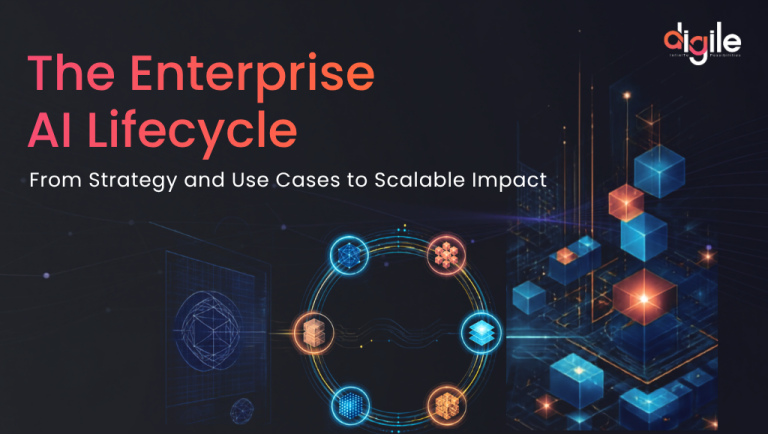
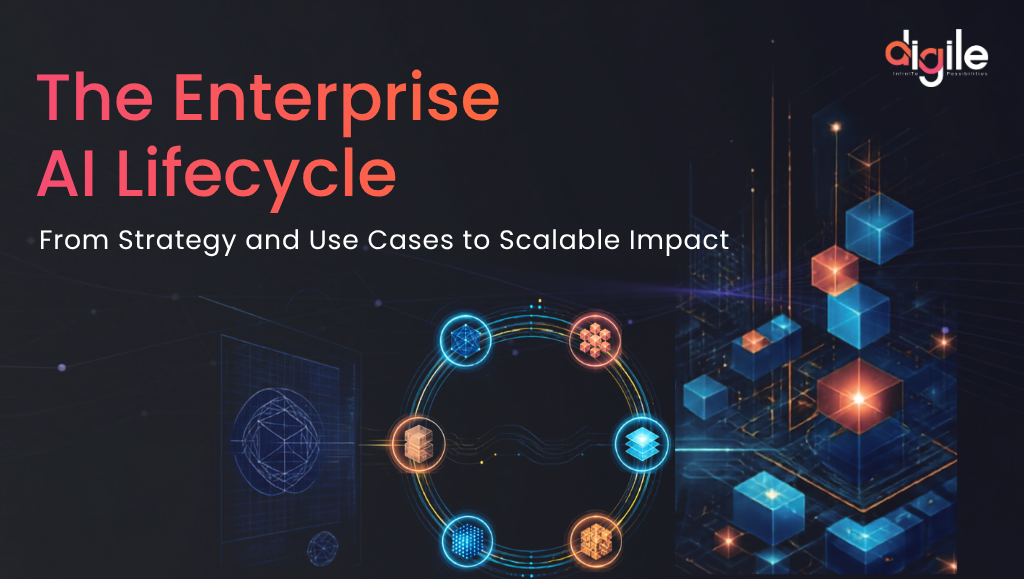
The Enterprise AI Lifecycle
Seen together, the lifecycle looks less like a traditional technology implementation and more like a continuous loop:
- Define the business strategy
Identify where AI can materially influence enterprise priorities. - Discover and prioritize use cases
Evaluate opportunities based on value, feasibility, risk and scalability. - Establish data and knowledge readiness
Give AI secure access to trusted enterprise context. - Build reusable AI foundations
Create common architecture, integration, security, orchestration and governance capabilities. - Prototype rapidly
Test assumptions before making large investments. - Prove business value
Measure outcomes, not simply technical performance. - Industrialize and govern
Engineer successful use cases for reliability, security, compliance, observability and scale. - Embed AI into workflows
Redesign processes and enable people to work effectively with AI. - Measure and optimize continuously
Track technical performance, adoption, cost, risk and business impact. - Reuse what works
Turn successful patterns into enterprise capabilities that accelerate the next wave of AI initiatives.
And then the cycle begins again.
Because enterprise AI is not a destination.
Every successful deployment creates new data, new capabilities, new questions and new opportunities.
From AI Adoption to AI Advantage
The next phase of enterprise AI will not be defined by who experiments fastest.
Experimentation is becoming easy.
Models are increasingly accessible. AI capabilities are appearing inside enterprise applications. Employees can build prototypes in hours. Agents can be assembled faster than many traditional applications.
The differentiator will be what happens after the prototype.
Can the organization identify the right problems?
Can AI understand the context in which the business operates?
Can successful experiments survive production?
Can governance keep pace as AI becomes more autonomous?
Can capabilities be reused rather than rebuilt?
Can employees incorporate AI naturally into their work?
And, ultimately, can the organization demonstrate that AI has changed a meaningful business outcome?
That is the difference between having AI initiatives and building an AI-powered enterprise.
The organizations that create lasting advantage will not necessarily be those with the most AI projects. They will be those that develop a repeatable system for moving from strategy to use case, from use case to production, and from production to scalable impact.
Because the real enterprise AI opportunity is not deploying one transformative use case.
It is building the capability to deliver the next fifty faster, safer and with greater impact than the first.
